
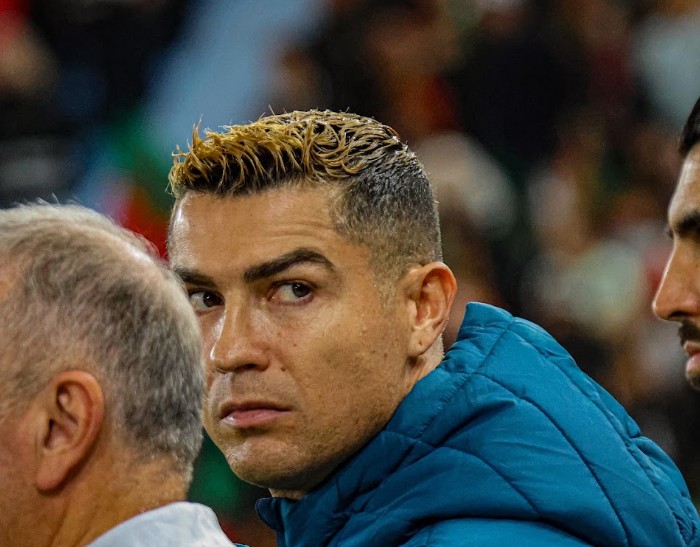
A lawyer consulted by the Portuguese sports newspaper A BOLA explains that the sanction is practically inevitable, but points to factors that speak in favor of the captain of the Portuguese national team. “Speed” must be the key word in the process.
The interruption of the national team’s training camp on September 30 left Cristiano Ronaldo in an unprecedented disciplinary situation after over 23 years with “Quinas” on his chest.
Cristiano Ronaldo reveals his truth behind his feud with Jorge Jesus
Gonçalo Almeida, a lawyer consulted by A BOLA, explained the process triggered by the behavior of the 41-year-old striker in Denmark, referring to article 160 of the Disciplinary Code of the Portuguese Football Federation (FPF). It establishes that a player who is “regularly summoned, leaves or does not unjustifiably participate in training, matches or activities for the national teams or in connection with the sports representation of the FPF or Portugal, is punished with a suspension of 1 to 6 months and, incidentally and if he is a professional player, with a fine between 5 and 10 UC [between 510 and 1,020 euros].”
“I don’t see any way he can’t be sanctioned,” he said.
If the first paragraph “is exhaustive” regarding the application of a sanction, the second indicates that “absence or abandonment automatically determines the preventive suspension of the player.” Gonçalo Almeida, who is also a referee at the FIFA Football Court, explains that in this way, Ronaldo “is already suspended from participating in or representing the national team.”
“Then a process must be initiated by the disciplinary council of the federation, and for which Cristiano, given the principle of adversarial processes, will be notified to renounce it, and then we will have a decision that I think will come quite quickly,” he described, before confirming that the captain of the national team can list witnesses.
Gonçalo Almeida explained that the FPF’s disciplinary committee “can act without the need for a formal complaint” because “the facts are public.”
The Disciplinary Board can act without the need for a formal complaint
Ronaldo announced his resignation from the national team’s training camp on September 30 on social media, the eve of the match in Denmark, after justifying the decision in a statement on Tuesday. Such a public confession should play in favor of the captain of the national team.
It concerns article 244 of the FPF’s Disciplinary Code, which states that “the defendant may at any time confess the facts that are the subject of the case” and “if the confession is complete and unreserved, and does not cast doubt on its credibility, no other evidentiary measures are taken and the minimum and maximum limits of the sanctions in force are halved”. Gonçalo Almeida stressed that the Portuguese star “fully and unreservedly confessed his resignation” in the publications he wrote on the subject.
In this way, “if the disciplinary board so wishes”, the sanctions will be halved. In the “best scenario” for the national team captain, the minimum sentence of one month and 510 euros will be a 15-day suspension and a 255 euro fine.
Cristiano Ronaldo risks a six-month suspension for leaving the national team’s training camp
Portugal will play again on November 14, against Denmark, in Braga, three days before visiting Wales. Considering that the automatic suspension period is deducted from the sanction imposed by the disciplinary board, there is a possibility that Cristiano Ronaldo will be free for the next commitment window for the Portuguese national team.
However, it all depends on the deadline for the decision of the disciplinary board.
“If Cristiano’s return happens, it is neither in the interest of the disciplinary board nor the federation that he is suspended for a long period of time,” he reiterated.
Exacerbating circumstances … and extenuating circumstances
Cristiano Ronaldo reiterated his full availability to serve a suspension period in a statement published on Tuesday.
“I understand that the punishment should not have mitigating circumstances. I am not just any player, I am the team captain, and that is an aggravating factor. I have already apologized, but I know that attitudes must have consequences,” he stressed.
Gonçalo Almeida admits that Ronaldo’s captaincy status is an “aggravating circumstance”, but points out that “he has no registration in this disciplinary chapter” and “gave everything to the national team” for more than 20 years. According to the first paragraph of Article 44 of the FPF’s Disciplinary Code, “the absence of a disciplinary record in the same season and in the three seasons preceding the one in which the defendant is registered with the FPF”, “provision of services relevant to football” and “praise for sporting merit” are among the circumstances considered mitigating.
For Gonçalo Almeida, the absence of a “well-defined case law” strengthens the analysis in a “case-by-case” way. In this way, the lawyer relativized the one-year suspension of all activities related to the national team imposed on Ricardo Carvalho in 2011, after a national team practice was suspended.
What Cristiano Ronaldo said when Ricardo Carvalho left the national team’s training camp
Therefore, the lawyer believes that the disciplinary board “will certainly not be unaware of this context” or “immune to all this fuss”.
Antonio Nusa is called up for the title fight in the Premier League!