Two 17th places in a row in the Premier League and a start to this season that seemed to be getting even worse! – But now matches are being won one after another.
That is the big question dominating Premier League discourse these days: Are Spurs really any good, or what?
Okay, maybe that’s not the big question. Or even a big question at all. But that’s the question that arises after a 2-0 win over a ten-man Sunderland – a match that gave a) the fifth league win in the last six games after just three wins in the first 26 Premier League games of 2026, and b) a sixth clean sheet in the last ten games, but crucially also c) absolutely no useful answer to the initial question, no matter how big it is.
Sunderland hosted Tottenham at the Stadium of Light. – After Tottenham took all three points, the London club has definitely put the relegation battle behind them.
What we think we can say about the Spurs now is that they are at least almost a good team. It shouldn’t be as surprising as it is to note that the Spurs are a team with an identifiable method and philosophy. The Spurs haven’t had it for so long, and so few teams this season possess it. And that this season, being almost a good team with a clear identity, can carry them quite far if they eventually manage to develop into actually good ones.
There’s a lot to like. There was something whimsical about the way Roberto De Zerbi nonchalantly made six changes to the starting eleven from last weekend’s win against Ipswich. It’s a decadent luxury to be able to do that kind of nonsense without significantly weakening the team, especially for a club like Spurs who play one game a week this season, and particularly at home to a Sunderland team desperately struggling to field a functioning team twice a week.
It felt like taking it lightly, but more precisely a sign that De Zerbi is still trying to figure out exactly what his best team really is. We still don’t quite understand his reluctance to just build that team around a midfield with Sandro Tonali and Mateus Fernandes, but what he does clearly works, and it is. It’s not like he chooses bad players in their place. Just some who aren’t quite as good, and apparently without any necessary reason, but so far without much cost.
Spurs’ attack this time did not have Luca Williams-Barnett from the start, with Omar Marmoush trusted on the left side and did … okay. His agile turn and run after 10 minutes created the most significant individual moment of the match, provoking an embarrassed Thomas Meunier to rake his studs down the Egyptian’s Achilles – a fully deserved red card after a VAR review.
It’s the third red card against Spurs in recent weeks, which in itself is part of what makes it so hard to determine if they’re actually any good. Meunier absolutely can’t complain, because it really looked like an attempt to hurt a player who had humiliated him, with the ball barely in the same postal code when he went into the tackle.
But Spurs fans will inevitably have some questions about how the actual verdict over the referee’s microphone – “After review, Sunderland number 12 hits the opponent with the studs. It’s serious play. The final decision is a red card” – aligns with Jayden Bogle not being sent off in the only loss Spurs have had in recent weeks, against Leeds a few weeks ago.
That didn’t exactly change the game, just cemented and cemented what was already the likely game. Spurs wanted a lot of possession, they would struggle to break down Sunderland, who mostly lived off counterattack chances.
Sunderland dropped deeper from a mid-zone to a low block, but – to their credit and Spurs’ annoyance – they never fully withdrew from the ‘counterattack’ part of the plan.
Especially in the final minutes of the first half, when they had several real chances to equalize. Spurs survived it, and a risky first five minutes of the second half, and then mostly controlled the events.
We may still not have definitive answers about Spurs in general, but this was a match that hardened some of our perceptions of their defensive stats, which are undeniably if strangely excellent. Since conceding three at home against Aston Villa in September, they have only conceded three more in their last seven games.
We are by no means convinced that they actually defend themselves better than they did during that period, or during the miserable periods of Thomas Frank and Igor Tudor last season. They just do much less of it.
When the Spurs defend, it feels as likely as ever that a disaster will happen, as it almost did late in the first half when Wilson Isidor came between the Spurs’ center-backs with disturbing ease.
But when you have a division-leading possession of 64 percent compared to just under 50 percent last season, there are simply fewer chances for these mistakes to happen – and for them to matter when they do.
Six clean sheets for Toni Kinsky, more than anyone except David Raya and Bart Verbruggen, is now an extreme, though not entirely inexplicable, result of the dominance the Spurs generally enjoy in possession statistics.
What the Spurs definitely are is a more captivating football team with James Maddison in it. He’s not perfect, but he has a creative spark and a flair for the whimsical that not many can match.
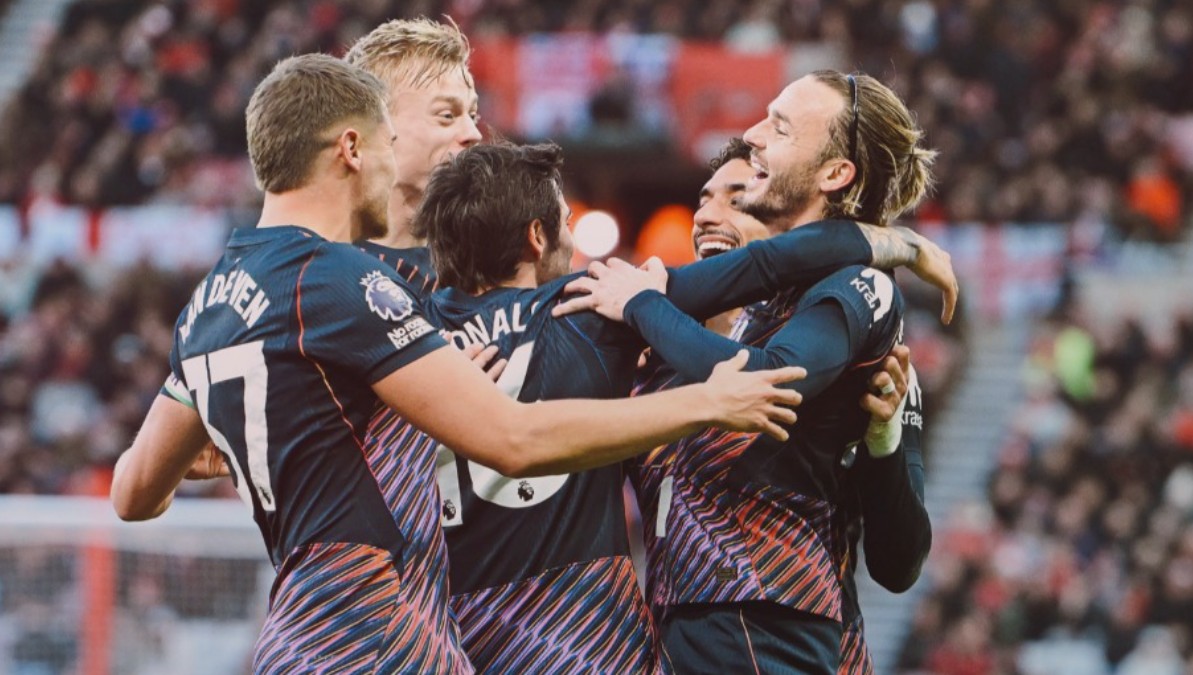
His two goals decided the match here, and the first was a rare piece of truly beautiful football in what Sunderland, out of necessity, made a deeply physical game. Marmoush and the excellent Andy Robertson combined beautifully on the left side, and the latter’s low cross was beautifully flicked in by Maddison. It was an even better finish than it looked, and simply one no other Spurs player would have thought of – let alone executed. It was a goal with strong “Early Angeball” vibes. Easy to forget now how often he made that kind of late run into the box before his various knee injuries.
Only Maddison knows if he meant the second goal (he didn’t), which we learn was the 22nd. “Olimpico” in Premier League history. It was definitely a good one, because it swung a whole mile from the starting line and put Robin Roefs to shame and bounced in via his post. Our suspicion is that Maddison actually went for the big swinging pass to the man behind the far post, and that the wind took it.
But that made the last 20 minutes comfortable for Spurs. For Sunderland, it intensified the misery not only in this match but in a season falling apart. It came moments after Enzo Le Fee collapsed on the floor with no one nearby. We all know it rarely ends well, and a Sunderland team sitting in the bottom three and already missing Dan Ballard, Granit Xhaka, and Brian Brobbey simply cannot handle any more spinal interventions before a December that includes eight matches across three tournaments.
Spurs making six changes to the starting eleven is now a show of strength; for Sunderland, it would have been a cry for help.