Spain’s World Cup victory on Sunday 19 July is the latest gem in a long line of triumphs – for men, women and youth national teams. It underlines the dominance of a system that has never abandoned its tactical identity, and which has constantly focused on developing collective talent.
The men’s team is already the reigning European champion, Olympic gold medalist, and has reached the Nations League final twice – and won it once. The women’s team are the defending world champions and double winners of the Women’s Nations League, as well as reaching the European Championship final in 2025.
Read: Promises Manchester United fans will love new signing Tynan Thompson
Spain is the first country to boast both the men’s and women’s World Cup titles at the same time – and the only country with two men’s World Cup triumphs this century. In addition, the nation has won a number of youth tournaments in recent years, on both the men’s and women’s sides.
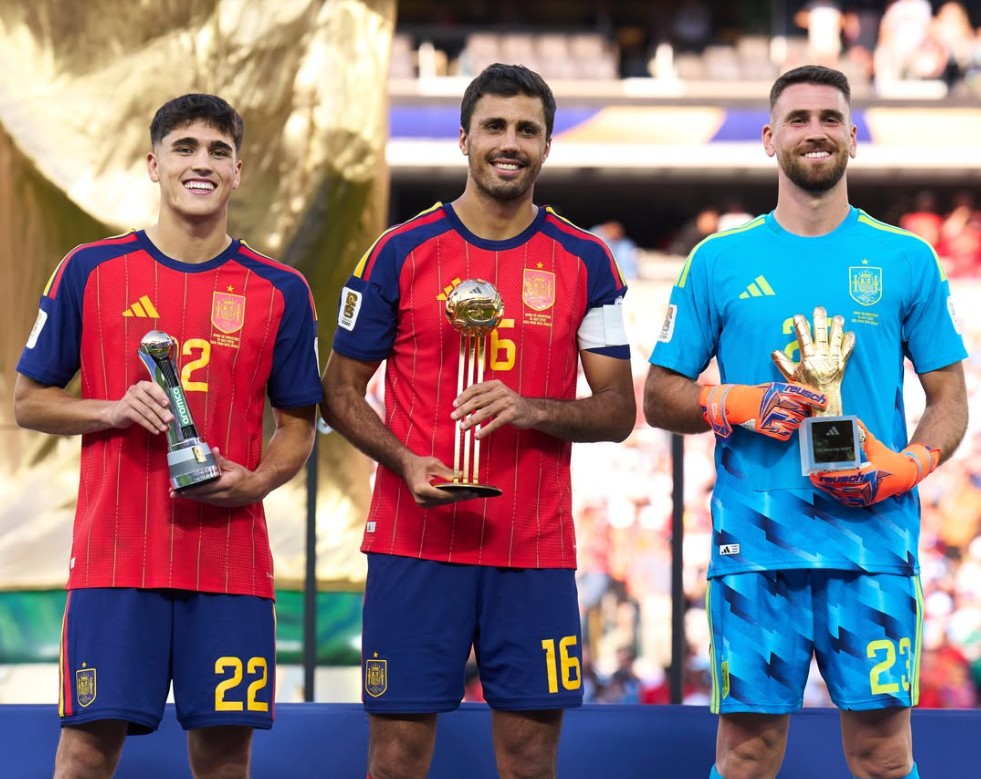
The success is the result of a gradual rebuilding after a golden generation – with names such as Andrés Iniesta, Xavi Hernández, Sergio Ramos and Gerard Piqué – secured Spain’s first World Cup title in 2010. Now a new generation has taken over. Lamine Yamal, Pau Cubarsí, Rodri and Ferran Torres – the latter of whom won the match 1-0 against Argentina in the final – have lifted La Roja back to the absolute top of the world.
“I am touched when I look back,” says Spain’s national team manager Luis de la Fuente. “We have talked about it with the players. We’ve won everything – it’s absolutely fantastic. This generation of players has become a role model for Spanish sport, for young Spaniards, for the whole of Spain. Together we are stronger.
Spain had not made it past the last eight of a men’s World Cup since the gold rush in South Africa in 2010. But since De la Fuente took over in 2022, the team has been in the game in almost every tournament. And the unbeaten streak of 38 games is the longest in the history of the men’s national team.
Collective talent
Despite an exceptionally talented squad, it has been the collective that has impressed the most. Spain has not been dependent on single stars – quite the opposite. The defense has been rock solid, and the hunt to recapture the ball has been relentless.
“We played against the best team in the world, but we were the best team in the world,” De la Fuente said. “I’m incredibly proud of this group. They have grown with the idea, been loyal to it, and shown us what it means to be a group, a team, a family. It has been an honor.
Read on Radiosporten: Only a matter of time before Ole Gunnar Solskjær lands the next big coaching job
Can others copy the system?
“Just get started,” said former France star Thierry Henry, who was a commentator for Fox Sports after the final. “Think about how you want to work at all levels – and play in the same way. That is why they dominate world football at all levels, both men and women. It doesn’t matter – they do it the same way.
Success in the youth ranks
The latest wave of success can be traced back to the appointment of De la Fuente – a choice that surprised many. He took over from Luis Enrique, after Spain were eliminated by Morocco in the last eight of the 2022 World Cup in Qatar. At the time, De la Fuente was relatively unknown to most people, but the Spanish Football Federation knew him very well.
By giving him the job, Spain deliberately invested in its own youth work. De la Fuente had coached the younger national teams for a long time, and knew the federation’s process from the inside – how to inculcate a clear tactical identity at all levels, from the bottom up, and across men’s and women’s teams. In this way, the transition from youth teams to A-national teams will be seamless.
That’s exactly what has happened with players like Yamal, Cubarsí, Nico Williams, Pedri and Gavi – young talents who will keep Spain’s men’s team at the top for years to come.
“When you look at everything we’ve been through, you realize how important this process has been,” says De la Fuente. “We probably wouldn’t have been able to do this today if we hadn’t gone through that journey with these players. And this didn’t just happen during this World Cup – it’s been going on for several years.
Tactical identity
Spain’s famous “tiki-taka” style – with an emphasis on possession and quick, precise passing – earned them the World Cup title in 2010 and European Championship gold in 2008 and 2012. As the team began to struggle, the style was criticized. Some thought it lacked efficiency, and several coaches tried to adjust it.
But Spain never completely gave up on the idea of controlling the ball to control the games. De la Fuente’s great achievement was to combine possession with real efficiency – which was shown when Spain led this year’s World Cup in both the number of passes and the number of goal attempts.
Coaching skills
De la Fuente’s success has quickly placed him in the ranks of Spanish coaches who characterize world football – both at national team and club level. Pep Guardiola, Luis Enrique, Mikel Arteta, Unai Emery, Xabi Alonso, and Roberto Martínez are just a few of the names spreading Spanish tactics across the globe – another testament to Spain’s immense influence in modern football.
“We are exactly where we want to be,” says De la Fuente. “We are privileged to represent a fantastic national team with extraordinary players. But the real advantage we have is that we find good travel companions – people with values and principles that make life easier, while also being insanely talented. Now we are going to enjoy this moment – because it is historic. Then we start thinking game by game again.
Finally, a description of how fantastic captain Martin Ødegaard is