
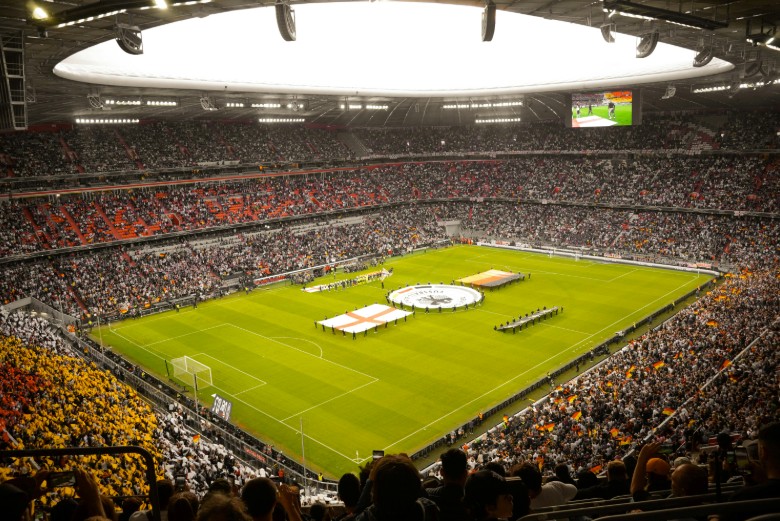
On June 11, the biggest sporting event of the summer kicks off at the Estadio Azteca in Mexico City. The 2026 World Cup is not only historic because of the format that this year consists of 48 teams, 104 matches, three host nations and 16 cities divided between the USA, Canada and Mexico.
What really sets this championship apart from all the previous ones is the infrastructure that lies at the bottom. From VAR to blockchain, from digital avatars to crypto technology in ticketing systems, the 2026 World Cup is becoming a technological divider for international sport.
VAR 2.0: players are scanned into digital avatars
The technology of offside decisions has been discussed since VAR was introduced, and the criticism has mainly been about inaccurate representations of players’ bodies in the semi-automated systems. This is a problem FIFA is trying to solve.
In January, FIFA President Gianni Infantino and Lenovo’s CEO announced that all of the 1,248 players in the 48 participating nations will be digitally scanned and recreated as accurate 3D models. The process takes about one second per player and captures body measurements with millimeter precision. The semi-automated offside system uses between 10 and 14 dedicated cameras per stadium to track 29 skeletal points on each player, and the new technology increases the amount of data from around 600,000 data points per team to 172 million data points.
As a result, VAR decisions will no longer be based solely on generic figures, but on the player’s actual body dimensions. The 3D models will be integrated directly into the TV broadcast, so that offside decisions can be presented much more realistically and understandably to spectators in the stadium and TV viewers around the world. This means that the controversial images that have sparked anger and confusion for years will be replaced by more precise and more realistic animations.
In addition, a new “referee angle” is introduced in the broadcasts, this is a camera of the referee himself, which is stabilized with AI in real time to give viewers a unique perspective from the middle of the pitch.
Football AI Pro
One of the more subtle but long-term important technology moves is Football AI Pro, a generative AI tool that all 48 participating countries will have access to during the tournament. The system can analyze hundreds of millions of FIFA data points and process over 2,000 football-related parameters, including pressing, movement patterns, tactics, and transitions.
The point of this is fairness: a Uruguay coach should have access to the same analytical tools and opportunities as someone who works for England or Brazil. SanDisk estimates that the tournament will generate over 90 petabytes of data, about 45 times the amount produced during the Qatar 2022 World Cup. These are not just big numbers, they are an indicator of a shift where data has become an independent product alongside the matches themselves.
FIFA’s blockchain-based ticketing system and the regulatory debate
Perhaps the most controversial technology innovation leading up to the 2026 World Cup is FIFA’s own blockchain-based ticketing system. FIFA launched a so-called “Right-to-Buy” system where tokens sold on FIFA’s Collect marketplace give the holder a guaranteed opportunity to buy match tickets when the sale opens. The tokens can also be traded in a secondary market.
The system is built on FIFA’s own blockchain, developed in collaboration with Modex and based on Avalanche’s EVM-compatible network. The reactions have been divided. In October 2025, the Swiss gambling regulatory body Gespa opened an initial investigation into whether the tokens fall under Swiss gambling legislation. The case is not settled, but it illustrates a broader tension: when blockchain technology is used in ticket distribution at this scale, one is moving into a legal and regulatory borderland that existing legislation is not fully equipped to handle, as they have not dealt with similar situations in the past.
However, blockchain technology in the sports industry is not limited to ticketing systems. Crypto platforms have increasingly integrated sports as part of their offerings, such as crypto betting companies that use blockchain infrastructure to secure transactions and provide users with transparency around odds and outcomes. This type of technology use has become more common as the crypto sector has matured and gained increased credibility through its association with established sports communities.
Smart stadiums and digital fan experiences
The technology doesn’t stop at the referees and coaches. Fans inside the stadium will be able to point their phones at the pitch and instantly see live stats about the players, including speed, passing accuracy, and positioning through FIFA’s augmented reality features in the FIFA+ app.
Each of the 16 stadiums will have a “digital twin,” a live virtual replica of the stadium that allows organizers to monitor crowds, safety risks, and players’ health data from wearable sensors in real-time. Algorithms will predict the demand for food and merchandise based on weather, match schedule, and live scores. There is a level of operational intelligence that makes the Qatar 2022 World Cup feel like the Stone Age in comparison.
Seven companies are expected to run self-driving robotaxies in ten host cities during the championship, and Boston Dynamics’ Atlas and Spot robots will be used for stadium logistics and fan engagement on behalf of Hyundai Motor Group.
A crossroads for international sport
However, the 2026 World Cup is not a showcase for future technology, it is a real implementation of new technology in the world’s most watched sporting event. Six billion viewers, 104 matches and three nations as host countries make it a stress test no tech provider will want to fail in.
What does this do for Norwegian sports fans? In short: better and more explainable refereeing decisions, a richer digital experience both in the stadium and at home, and a championship where data and transparency have become as central as the ball itself. The 2026 World Cup kicks off on June 11, and the technology revolution is already underway.